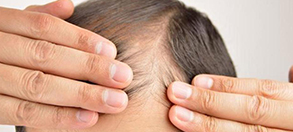
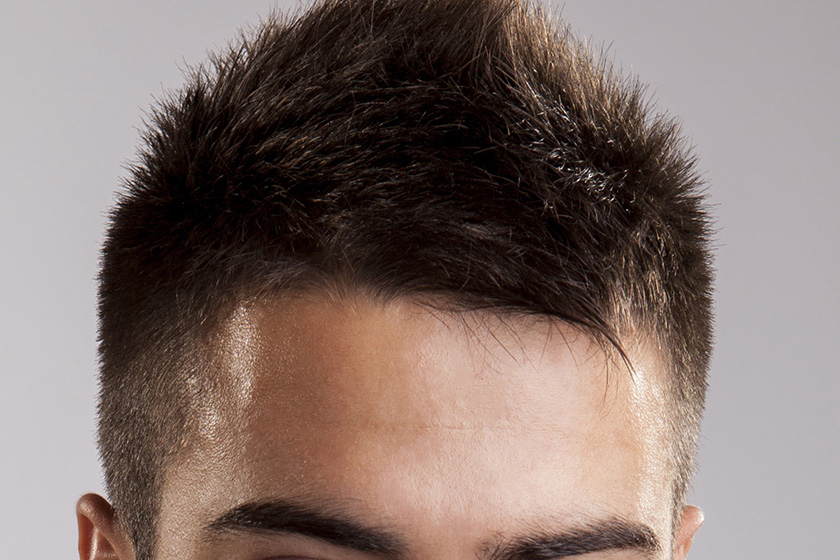
A crown hair transplant is a procedure that harvests and extracts healthy hair grafts from the back and sides of the scalp and transplants them to the crown area of the head to address thinning, balding, or shedding in that area. The crown of the head has one of the most complex growth patterns, often forming a spiral or whorl, meaning that it requires extra planning and care from the hair restoration specialist to ensure natural-looking results.
Houston Hair Transplant Center (HHTC) is one of the nation’s leading hair transplant clinics. Here, Dr. Goran Jezic and his clinical team offer exceptional crown hair transplants to help patients restore the density and thickness of their hair. His highly skilled hair transplant team members each bring an average of 10 years of specialized experience, combining technical precision with a deep understanding of natural hair growth patterns to deliver consistent results.
If you are ready to learn more about crown hair transplants, schedule a consultation by submitting our online contact form or calling our office directly at (713) 864-2300.
Contents
- 1 Before and After Photos
- 2 About Crown Hair Transplants
- 3 What Causes Hair Loss?
- 4 Candidates
- 5 Personal Consultation
- 6 Preparation
- 7 Recovery
- 8 Results
- 9 Cost of Crown Hair Transplant in Houston, Texas
- 10 FAQ
- 10.1 How is a crown hair transplant different from hair transplants in other areas of the scalp?
- 10.2 How many grafts are needed for a crown hair transplant?
- 10.3 How long will the results of my hair transplant last?
- 10.4 How long is FUE recovery?
- 10.5 Can my crown hair transplant be combined with restoration in other areas of my scalp?
- 11 References
Before and After Photos


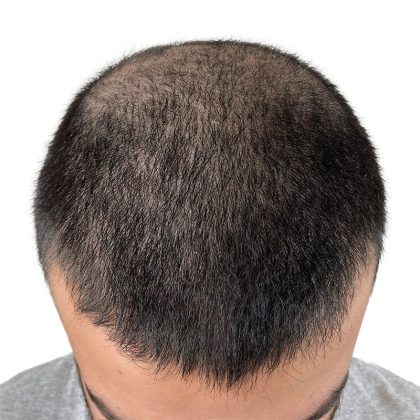
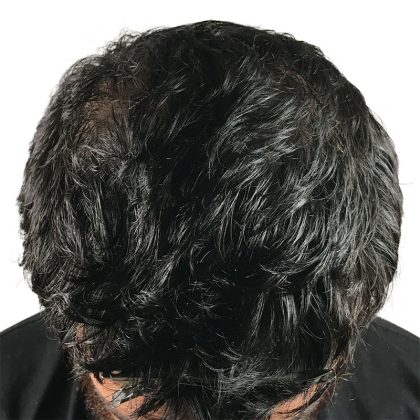
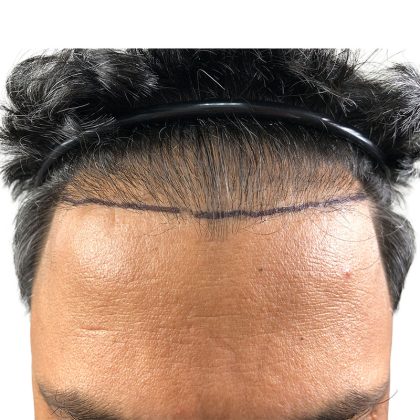
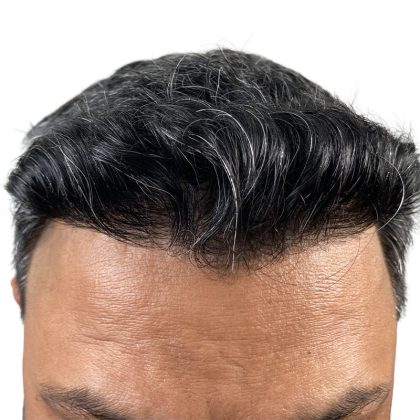
About Crown Hair Transplants
The crown, or vertex, is the uppermost area of the scalp situated toward the back of the head. It is a common site for hair thinning or loss. (1) At HHTC, our team can perform an FUE hair transplant to help restore the hair to the crown area.
About FUE
Follicular unit extraction or excision (FUE) is a minor surgical procedure that transplants healthy hair grafts from the back and sides of the scalp to areas experiencing hair loss. Each graft contains 1–3 hair follicles. This procedure extracts individual follicular units, avoiding linear incisions. (2)
Advanced Technology
Our clinical team can perform an FUE using technologies such as the Sapphire FUE and the ATERA FUE system.
Sapphire FUE: Sapphire FUE uses ultra-sharp sapphire crystal blades to create recipient sites for grafts. These blades produce smaller, cleaner incisions, enabling denser graft placement, faster healing, and minimal tissue trauma. The result is more natural-looking crown growth and an overall improved aesthetic outcome.
ATERA FUE: ATERA FUE is a digital, automated FUE system that enhances precision and efficiency. Key features include:
- Digital graft counting, so patients know exactly how many units were harvested.
- Moist and cooled storage of grafts during the procedure, maintaining follicle viability.
- Minimal trauma and bleeding due to a lighter handpiece.
- Optimized implantation, ensuring grafts are placed at precise angles and depths for natural hair growth patterns.
These advanced technologies allow our team to deliver high-quality, natural, and long-lasting results while ensuring a comfortable experience and rapid recovery for patients.
Procedure Details
On the day of the procedure at HHTC, your hair restoration specialist will shave or trim the hair in the donor area at the back of the scalp. They will also administer local anesthesia to ensure your comfort.
During your FUE, your hair restoration specialist will extract individual follicular units from the back of the scalp with great precision and care. They will transplant the grafts at precise angles and depths to mimic the natural hair growth patterns of the crown. The process typically lasts several hours, depending on the number of grafts. Typically, the procedure takes 6 to 8 hours.
What Causes Hair Loss?
Millions of people around the world experience the distress of hair loss. Many factors can cause or contribute to hair loss, including stress, genetics, and diet. Understanding the underlying causes is key to effective treatment and restoration.
Androgenetic Alopecia
The most common form of hair loss is androgenetic alopecia, also known as male or female pattern baldness. It is largely driven by genetics.
This condition impacts up to 50% of men and women, typically emerging after puberty and progressing gradually over time. (1)
In men, hair loss often begins at the crown or the areas along the hairline or temples. The hormones testosterone and dihydrotestosterone (DHT) play a central role in disrupting the natural hair growth cycle. Within the scalp, the enzyme 5-alpha-reductase converts testosterone into DHT, which then binds to hair follicles and shortens the anagen, or growth, phase. Over time, this process causes the follicles to produce progressively thinner, shorter hairs, eventually leading to noticeable hair loss. (2)
Candidates
Ideal candidates for crown hair transplants are typically men who show visible thinning or hair loss in the crown, or vertex, area of the scalp.
Anyone interested in a crown hair transplant should be in good general health and have realistic expectations for their results. During your consultation, our clinical team will evaluate your scalp and medical history to determine if a crown hair transplant is right for you. In certain cases, a biopsy may be recommended to identify the underlying causes of your hair loss.
Personal Consultation
Before scheduling your crown hair transplant, you will need to attend a personalized consultation at HHTC. During the consultation, Dr. Jezic or one of his lead clinicians will explain the available procedure methods and learn more about your medical history, concerns, and desired results. They will also evaluate your scalp and donor area.
Using the information provided, our clinical team will assess your eligibility for the procedure and, if appropriate, begin developing a personalized plan tailored to your needs.
To schedule this consultation, please submit our online contact form or call our office directly at (713) 864-2300.
Preparation
Proper preparation will help lay the foundation for a successful crown hair transplant. Our clinical team will provide you with a list of key considerations, often including:
- You would need to explicitly ask your doctor for consent to reduce or stop taking blood-thinning medications and supplements 1–2 weeks before and after your session.
- Avoid nicotine for several days to weeks prior to the procedure.
- Refrain from alcohol for 24–72 hours before your session.
- Get a full night of sleep before your procedure.
- Eat a light breakfast or snack on the morning of your session.
- Follow any additional preparation instructions provided during your consultation
Recovery
FUE is considered a minor surgical procedure. After an FUE procedure at HHTC, you can return to work after a couple of days, but you should continue to avoid strenuous activities or heavy lifting for at least one week. As the scalp heals, tiny scabs form around the implanted grafts, but it is important not to pick at these to preserve the health of the grafts.
After about 48-72 hours, we recommend gently washing the scalp with approved products to keep the area clean. Redness or tenderness around your scalp is also normal, but these effects will gradually subside on their own with proper postoperative care.
Results
Most hair transplant patients begin to see new hair growth after approximately 3 to 4 months. Results will continue to grow and improve in the following months. By about 9 to 12 months, the transplanted hair typically reaches its full thickness. Once fully grown, the results are generally permanent, as the transplanted follicles are resistant to the effects of DHT that cause androgenetic hair loss. With proper care and maintenance, your restored crown can retain a natural appearance for many years.
Cost of Crown Hair Transplant in Houston, Texas

The cost of a crown hair transplant will vary depending on the size of the treatment area and the number of grafts needed to help you achieve your desired results. Our clinical team will discuss the cost of your procedure with you during your personal consultation.
To schedule a consultation and learn more about the costs associated with crown hair transplants, please submit our online contact form or call our office directly at (713) 864-2300.
FAQ
How is a crown hair transplant different from hair transplants in other areas of the scalp?
Crown hair transplants are typically considered more complex than hairline transplants because the hair at the crown naturally grows in a swirling, circular pattern. This unique growth pattern requires careful planning and precise placement of each follicle to ensure the restored hair blends seamlessly and looks natural, whereas a hairline transplant generally follows a more straightforward, linear direction.
How many grafts are needed for a crown hair transplant?
The number of grafts needed will depend on the size of the treatment area and your desired density. In a single FUE session, up to 3,000 hair grafts may be transplanted.
How long will the results of my hair transplant last?
The results of a crown hair transplant with FUE are generally permanent, as the transplanted hairs are taken from the back of the scalp, which is considered more resistant to hair loss.
How long is FUE recovery?
Most patients can return to work after their FUE within a couple of days, although they will need to follow certain restrictions for up to a week or two following their session.
Can my crown hair transplant be combined with restoration in other areas of my scalp?
Yes, patients experiencing hair loss in other areas of their scalp may be able to address those areas in addition to the crown. You could ask about our MEGA Session hair transplants up to 5,000 grafts that can address hairline, top of the scalp, and crown hair restoration needs, and also harvest donor hair from the chest, back, abdomen, and arms. During your consultation, a member of our clinical team will be able to suggest the most appropriate procedures for your hair loss.
References
- Ho CH, Zito PM. Androgenetic Alopecia. Nih.gov. Published May 18, 2019. https://www.ncbi.nlm.nih.gov/books/NBK430924/
- Zito PM, Raggio BS. Hair Transplantation. PubMed. Published 2021. https://www.ncbi.nlm.nih.gov/books/NBK547740/