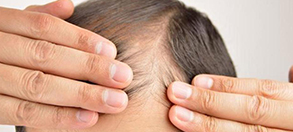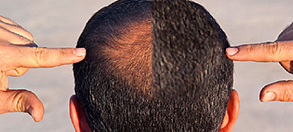
The African American hair transplant is a specialized surgical procedure designed to suit the attributes and complexities of Black hair. Characterized by its curly structure and thicker strand width, African American hair can often have a lower overall density (fewer hairs per square inch) than that of other ethnicities. (1) The hair’s tight, coiled structure can make it delicate and prone to breakage. More importantly, many hair transplant doctors and clinics are reluctant to perform hair transplants on men and women with curly hair due to the high transection rate during the harvesting & extraction process, which requires a high level of skill and precision.
Experienced hair restoration specialists like Dr. Goran Jezic and the team at Houston Hair Transplant Center (HHTC) are adept at addressing the hair needs of all ethnicities and committed to providing personalized care. Having performed thousands of hair transplants over the last decade, Dr. Jezic and the HHTC specialists utilize the most advanced hair transplant technologies to deliver optimal results. To learn more about HHTC’s approach to African American hair transplants and schedule your personal consultation, call our office at (713) 864-2300 or submit a request online.
Contents
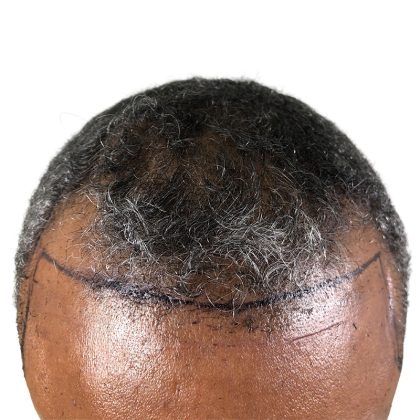
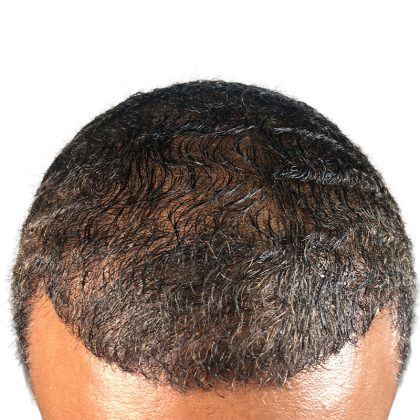
Before and After Photos


About African American Hair Transplants
It is essential to understand the ethnic, genetic, and cultural implications when approaching African American hair transplants. Considering differences in follicular structure, styling techniques, and other factors such as scarring or keloid formation will help deliver optimal results. (2) Black individuals are frequently more predisposed to certain hair and scalp conditions, such as alopecia and seborrheic dermatitis. (3) Chronic hair breakage and traction alopecia can result from the habitual strand tugging associated with many protective hairstyles (braids, weaves, etc.). An African American hair transplant preserves and enhances the natural characteristics of Black hair by restoring it to its healthiest potential.
African American Hair and FUE
Follicular Unit Extraction, also known as Follicular Unit Excision (FUE), is a methodical, linear incision-free hair transplant technique that harvests healthy hair follicles from donor areas and precisely places them in target areas. Donor areas are typically the sides and back of the head, where hair is more resistant to DHT, the main hormone that drives hair loss. While African Americans may have a lower density than that of other ethnicities, the curl, angle, and width of individual hair strands give it a thicker overall appearance, potentially requiring fewer grafts to achieve fullness. Curly hair also has curved follicles, posing a challenge for extraction that requires a skilled approach. HHTC’s hair restoration specialists will use specialized curved punches during extraction to follow the natural curl of the hair follicles and ensure an effective transfer.
Benefits
The benefits of an African American hair transplant can be just as psychological as they are physical. African American hair texture requires fewer grafts to cover thinning areas, meaning transplanting requires less donor hair. In addition to a restored hairline and natural-looking fullness, new hair growth will continue for sustained, long-lasting results. You will experience a renewed confidence in your enhanced appearance, and no linear scarring.
Candidates
Potential candidates will be African American men and women in overall good health who are experiencing significant hair loss yet possess sufficient donor hair. Non-African-American men and women with curly or wavy hair would also be great candidates for a hair transplant at HHTC. Candidates should be non-smokers or willing to abstain from nicotine use for an extended period of time around treatment. These individuals should be committed to following aftercare guidelines and hold realistic expectations about the hair transplant process. To explore your candidacy for an African American hair transplant, schedule your personal consultation at HHTC today.
Personal Consultation
At your complimentary consultation, one of our hair restoration specialists will evaluate your scalp, hair growth patterns and texture, donor availability, hairline structure, and discuss your goals, all with a focus on the nuances of African American or curly/wavy hair in general. After your assessment, they will address any questions or concerns you may have, then formulate a personalized treatment plan that aligns with your desired outcome. When you are ready to start your hair transformation journey with HHTC, submit our online contact form or call our office at (713) 864-2300 to schedule your consultation.
Preparation
Your specialists will provide you with more specific information to help you prepare for your hair transplant procedure. Generally, your doctor may advise you to suspend the use of blood-thinning medications, supplements, nicotine, and alcohol for a few days prior to the procedure. Do not stop any medications without explicit doctor approval. We ask that you arrange transportation to and from your procedure. To reduce stress and help you relax during your initial recovery, we recommend preparing a comfortable recovery space and scheduling time off work and demanding activities to rest.
Procedure
Your procedure will begin with Dr. Jezic marking your donor and recipient areas and administering anesthesia to numb the scalp. They will then carefully harvest grafts from the donor area and place them in the recipient area at the right angle and orientation to achieve cohesive volume and flow. It is delicate work, and our hair restoration specialists take a calculated, precision-minded approach to place grafts for optimal fullness and lasting results. We take special care to preserve curved hair follicles so they maintain natural movement patterns in their new placement. Your procedure may last 6–8 hours, depending on the number of grafts necessary.
Recovery
FUE recovery time is typically faster and more efficient than conventional procedures, often requiring only a couple of days of downtime. You can return to work and non-strenuous activities within the week; however, you will need to avoid direct sun exposure and strenuous activity until Dr. Jezic or one of his clinicians gives you clearance. You may experience some swelling in the scalp and forehead area for the first couple of days, but it will subside. Tiny scabs will form along your scalp, and it’s important to let them fall away naturally so as not to disrupt the grafts. Donor hair will start to shed as a normal part of the healing process. Follicles will be at rest in preparation for new growth.
Results
Visible results will start to appear gradually, at three or four months, with finer hairs sprouting in previously bare areas. Hair density will continue to improve, and transplants will strengthen and grow longer. Final results may take up to a year or longer to fully develop, depending on pre-transplant hair conditions and goals. Once the extraction areas fully heal, scars will be barely detectable, and you can start to enjoy your hair’s restored body, style, and movement.
Corresponding Procedures
At HHTC, we understand that hair is an essential part of confidence and self-expression. In addition to African American hair transplants, we offer non-surgical hair transplant treatments that work beautifully in tandem with FUE to help you achieve the most comprehensive results.
One of these is Autologous Conditioned Plasma (ACP), which harnesses the healing powers of your own blood to stimulate healing and new hair growth. Dr. Jezic and his clinicians also offer cellular micrografting and exos, both excellent regenerative, non-surgical procedures for men and women. These can be performed independently or in tandem with a hair transplant.
Another option is The Laser Cap, a wearable device that uses gentle red light energy to encourage cellular activity. This acts as an easy way to support hair growth from the comfort of your own home!
Dr. Jezic and the other knowledgeable clinicians can also recommend science-based, medical-grade shampoos and conditioners, as well as nutrient-rich vitamins and supplements to help support your hair restoration journey.
Cost of African American Hair Transplant in Houston
The cost of an African American hair transplant will vary depending on factors like the number of grafts, the size of the treatment area, and the complexity of your case. At your consultation, our team will provide a cost estimate based on your personalized treatment plan. In the meantime, don’t hesitate to reach out with any questions by calling our office at (713) 864-2300 or submitting a contact form online.
FAQ
Can I wear protective styles or relax my hair post-transplant?
We recommend that you let your hair and scalp rest and breathe for at least six months before reintroducing harsh chemicals or any hairstyles that require tugging at the strands.
Will my natural curls be intact after the transplant?
Yes. The hair restoration specialists at HHTC take pride in their artistry, precision, and ability to restore the natural shape and movement of all hair types and textures.
Is a hair transplant painful?
Receiving local anesthesia is the most painful part of the procedure, but it is a brief period followed by comfortable numbness. Once you are home and recovering, you may experience sensations of tightness, warmth, itching, and mild discomfort that should resolve quickly.
How long will it take for new hair to grow?
Once your transplants settle, rest, and enter the growth phase, fine hairs will start to appear at three or four months. Full results will emerge around the year mark.
Will hair from the donor area grow back?
No, which is why it is essential that you possess sufficient donor hair and you work with a highly skilled clinician who is judicious, artful, and precise during graft selection. When done well, the overall area will appear natural and well-blended.
References
- Sperling LC. Hair density in African Americans. Arch Dermatol. 1999 Jun;135(6):656-8. doi: 10.1001/archderm.135.6.656. https://pubmed.ncbi.nlm.nih.gov/10376692/
- Rogers NE, Callender VD. Advances and challenges in hair restoration of curly Afrocentric hair. Dermatol Clin. 2014 Apr;32(2):163-71. https://pubmed.ncbi.nlm.nih.gov/24680003/
- Lee H, Jung SJ, Patel AB, Thompson JM, Qureshi A, Cho E. Racial characteristics of alopecia areata in the United States. J Am Acad Dermatol. 2020 Oct;83(4):1064-1070. doi: 10.1016/j.jaad.2019.06.1300. Epub 2019 Jul 3. https://pubmed.ncbi.nlm.nih.gov/31279016/